Hoyte was ahead of his time
October 13, 2026·4 min read
Thread
Oct 13, 2026KW
Hoyte was ahead of his time
Surujdai JuglallDear Editor,
I refer to a letter dated October 11, 2026, from Mr. Khemraj Harryram[1], and I wish to thank him for researching this piece of our history that the PPP has tried to erase: the role many played in preparing the ground for the 1992 elections and the handing over of political power to Dr. Cheddi Jagan upon his victory.[2]
I wish to speak of one man who was ahead of his time—Hugh Desmond Hoyte.
Hoyte was one of the most incorruptible and dignified figures ever to serve in Guyana’s history. His only real competitors for that distinction would be Jagan and his wife, Mrs. Janet Jagan. When the true history of this country is written, the name Hoyte, like the Jagans, will be acknowledged as one of the small handful of sincere patriots that had the privilege of serving this nation at the highest level.
Hoyte served as Guyana’s Home Affairs Minister from 1969 to 1970, Finance (1970 to 1972), Works and Communications (1972 to 1974), and Economic Development (1974 to 1980). After the rigged 1980 elections, he was appointed one of five vice-presidents to Burnham, responsible for economic planning, finance, and regional development, particularly the State Planning Secretariat. In August 1984, Hoyte became Prime Minister and First Vice President, continuing to oversee the State Planning Secretariat. In 1985, he became President until he lost power in 1992. He continued to pay keen attention to the State Planning Secretariat and to a department called the Department of International Economic Cooperation during his Presidency.
The 1985 elections, in which Hoyte was the Presidential Candidate, were rigged. However, he was part of a machinery over which he had limited control, just after the death of Burnham. He was the Candidate on paper, while the real political bosses at the time were operators out of Congress Place. In short, he was a casualty of a system that included Hamilton Green and Robert Corbin.
Guyana is fortunate that he stayed his hand and carefully managed these hardliners, for had he rocked the boat, he would have lost political power to them, since they were much stronger than him politically in 1985. Without a moderate voice like Hoyte’s in office after 1985, there would have been no Jagan presidency. The hardliners in the PNC in 1992 had a plan to keep power and were willing to work that plan by whatever means necessary. It took Hoyte to stop them in 1992.
The real history of Guyana will show that the General Secretary of the PNC from 1985 to 1992 was Corbin, and the Deputy Leader from 1985 to 1992 was “Hammie”. Use that information to work out the arithmetic.
Throughout his entire period in public service, the only tangible asset of any substance the Hoyte family owned was a house on North Road, after serving at the highest level of Government in the Cabinet for 23 years. He had no 60-acre farm on the Linden Highway, no mansion at Leonora. Nor did he have any 10% stake in the assets owned by members of the selected cricketers’ clan (more than 10% of the prime properties in parts of Providence and on the Ogle to Eccles Road, certain malls both in Guyana and abroad).
His significant achievement was what he did after 1985. He had taken over a country from Burnham in 1985 that was in severe fiscal crisis, where it took 102% of total government revenue to service the national debt. After paying the debt, there was no money to pay even wages and salaries for public servants. By 1986, Hoyte knew with clarity that time was no longer on Guyana’s side.
He therefore quietly committed to the IMF in 1986 to a comprehensive programme to reduce the debt, rebalance the economy and open it to private investors under a comprehensive Economic Recovery Programme (ERP), strong enough to “elicit the appropriate external financing and debt restructuring.”
Just ask Mr. Carl Greenidge, who was at the table with Hoyte when they spoke to the IMF in 1986, in a meeting in which Mr. Alexandre Kafka (1917–2007) was the lead spokesperson.[3] Kafka was a prominent Czech-born economist and naturalized Brazilian citizen who served as an Executive Director of the IMF for 32 years (1966 to 1998).
Also in the room was Mr. Dara McCormack (1943–1996), an Irishman who represented the Caribbean as Executive Director at the IMF at the time.[4] It was Mr. McCormack who said the policy response before 1986 was “ad hoc and in retrospect, clearly inadequate.” That was because of Burnham’s medically unfit executive instructions. Some say that in his final days, Burnham was borderline delusional.
As the graph below reveals, by 1989 Hoyte had reduced the external debt by 13%, which paved the way for vital new inflows to be injected into the economy in 1990 and 1991. It was Hoyte who first created the economic impetus to start paying the debt on a predictable basis thereafter, until Asgar Ally and Bharrat Jagdeo came.
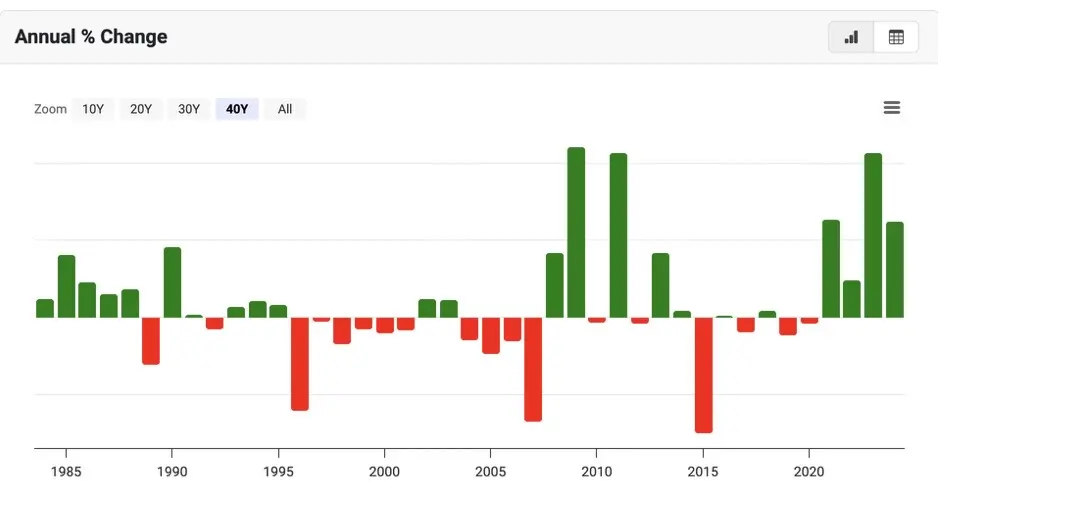
By 1991, the revenue it took to service the debt had stabilized to 105%, as part of a medium-term plan that created the economic momentum to reduce this drain on the revenue used to service the debt to 59% by 1993, mere months after the PPP secured power. Asgar Ally and Jagdeo continued the ERP and HIPC Programme conceived with the IMF by a team that was formed under Hoyte, and that strategy bore fruit since by 1996 it took only 42% of the revenues to service the debt, leaving more cash for human development projects.
Hoyte knew that a continuation of the Burnham policy would lead to more scarcity of food, accelerated inflation, and a rejection of Guyana by the international community. As President, it was his patriotic duty to do something for his people, and fast, but within an environment that balanced the political mannerisms of the PNC Central Committee with the terms of the ERP that was being formulated with talent like Carl Greenidge, Haslyn Parris, Cecil Rajana, Michael DaCosta, and others, in conjunction with the IMF.
Guyana can learn much from the Hoyte era.
Yours faithfully,
Surujdai Juglall
Surujdai Juglall
References
- Mr Rohee’s letter overlooked many other Guyanese and international figures in the October 5th story - Kiskadee Watch — kiskadeewatch.com ↩
- Cheddi Jagan Elected As Guyana's President — www.nytimes.com ↩
- Hoyte explains Guyana-Venezuela trade pact — www.caymancompass.com ↩
- Latin American, Caribbean Countries Represented on IMF Board — exa.ai ↩